
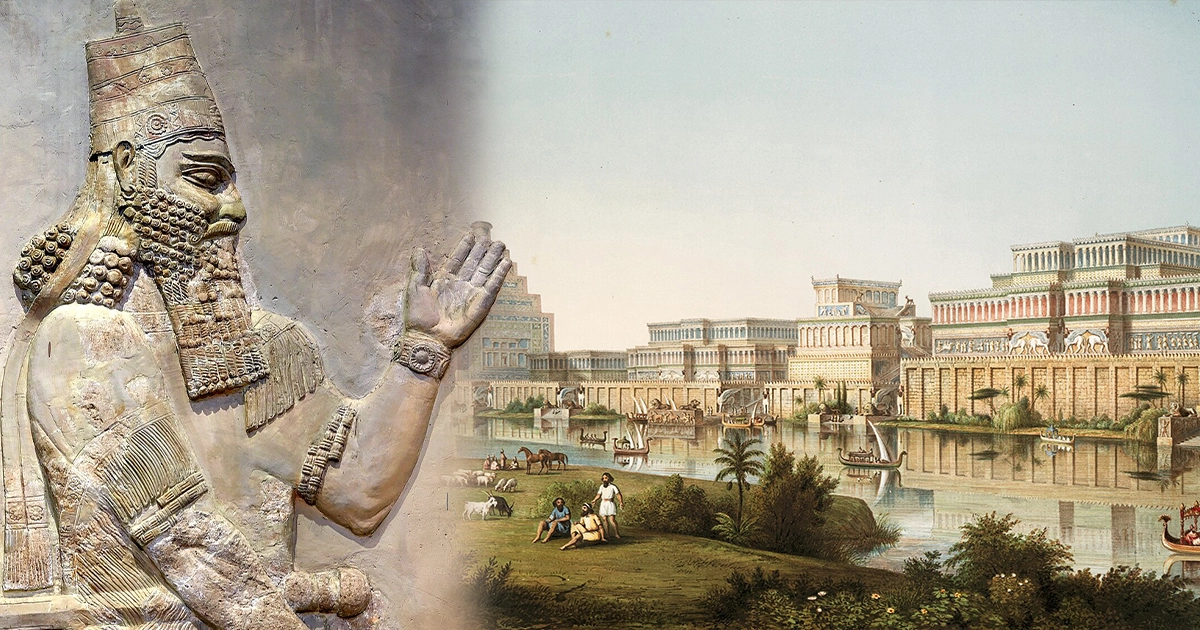
In the autumn of 701 BCE, Sennacherib’s forces took the Judean city of Lachish after an assault calculated not only to breach walls but to destroy the will of every kingdom watching from a distance. Within the following decade, royal craftsmen had carved the entire campaign onto gypsum-alabaster panels lining Room XXXVI of the Southwest Palace at Nineveh, a space every foreign envoy awaiting audience was required to cross. This is Neo-Assyrian propaganda at its most deliberate: military violence transformed into permanent administrative theatre. The empire that stretched from the borders of modern Iran to the gates of Egypt ruled for over three centuries, and its system of ideological control through stone, clay, and careful staging explains much of how it lasted as long as it did. Understanding how Assyrian kings built that system reveals one of the ancient world’s most sophisticated experiments in imperial communication.
Palace reliefs as instruments of Neo-Assyrian propaganda
Harvard art historian Irene J. Winter, William Dorr Boardman Professor of the History of Art and Architecture, fundamentally shifted how scholars interpret Assyrian wall art. In her 1981 essay “Royal Rhetoric and the Development of Historical Narrative in Neo-Assyrian Reliefs,” Winter argued that what distinguished Assyrian palace imagery from earlier Near Eastern examples was its systematic narrative sequencing: mustering of troops, the march, the siege, submission, punishment. The reliefs did not simply commemorate victories. They constructed a moving argument that tracked with the visitor through space. As Winter later wrote, the palaces functioned as an integrated architectural, pictorial and textual representation of the institution of kingship and the ideal of the Neo-Assyrian state.
The material was chosen for maximum impact. Panels were cut from fine gypsum-alabaster and set as orthostats, meaning free-standing slabs placed at human eye-level along corridor walls. Modern analysis including portable X-ray fluorescence work at Nineveh shows that the surfaces were once heavily painted. Arrows flew in red and orange. Blood appeared where it was supposed to appear. The carved outlines were scaffolding for a coloured assault on the senses entirely lost when we examine grey stone panels in museum galleries today.
Scholars have debated the precise audience for the most graphic panels. Paul Collins, in his British Museum Press study of Assyrian palace sculptures, along with others who have mapped spatial placement, noted that some brutality scenes occupied less accessible parts of the palace, away from main ceremonial routes. This does not weaken their function. It suggests a layered audience: the most extreme imagery reinforced hierarchy among officials who penetrated deepest into the building, while the sequences closest to the throne room, the ones a foreign ambassador most likely crossed, emphasised a controlled message of siege, submission, and tribute.
Ashurnasirpal II and the birth of pictorial narrative war art
The tradition that reached its fullest expression under Sennacherib began with Ashurnasirpal II, who reigned from 883 to 859 BCE and established his capital at Kalhu, the site today known as Nimrud in northern Iraq. The Northwest Palace there, excavated between 1845 and 1851 by Austen Henry Layard and re-examined by British School of Iraq teams under Max Mallowan in the 1950s, produced some of the most extensive palace relief sequences known from the ancient Near East. Winter’s 1983 study of the throne room programme at Nimrud argued that Ashurnasirpal was the first Assyrian ruler to deploy pictorial narrative in a systematic, ideological way. Previous rulers had commemorated victories in art. He turned commemoration into an ongoing argument for submission.
The Banquet Stele of Ashurnasirpal II, now in the British Museum (BM 118871), records a ten-day feast held to inaugurate Kalhu. The inscription lists 47,074 guests drawn from across the empire and states that the king treated them to a feast and sent them back to their lands in peace and joy. The stele is not a neutral administrative record. It is a broadcast telling every corner of the empire that the centre was wealthy, generous, and capable of feeding tens of thousands at will. Generosity, in this political grammar, was another form of power.
Ashurnasirpal’s carved lion hunt panels, also in the British Museum, illustrate the divine-mandate logic the empire used consistently. The king does not hunt because he enjoys it. He hunts because the destruction of chaos is his cosmic duty. Every lion that falls is a metaphor for every rebelling city. The framing inscription makes this explicit: the god Ninurta authorises the kill. Art and theology worked as a single system.
The Lachish reliefs: victory carved in gypsum
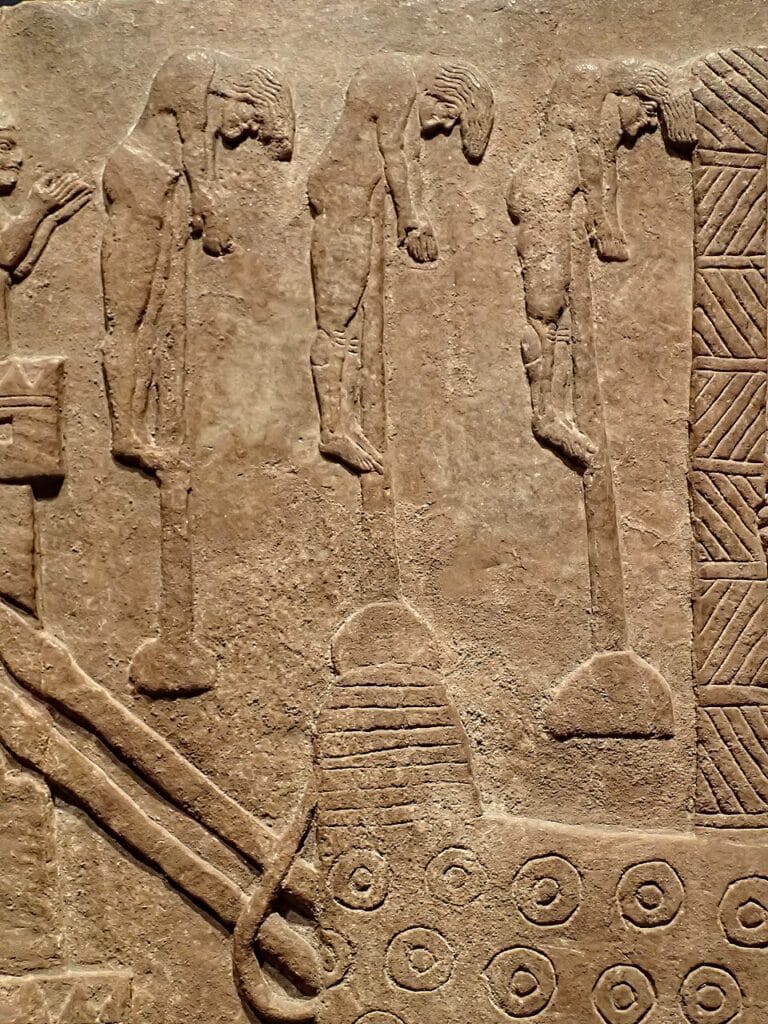
No Assyrian ideological programme is better documented or more precisely cross-referenced than the Lachish campaign of 701 BCE. The gypsum reliefs that once filled Room XXXVI of Sennacherib’s Southwest Palace, discovered by Layard and John George Taylor between 1845 and 1847 and shipped to the British Museum by 1856, depict the assault in extraordinary technical detail. The panels show the Assyrian siege ramp built from packed earth on the city’s southwest corner, four-wheeled battering rams advancing under wicker-and-leather mantlets, archers in disciplined rows firing from behind interlocked shields, and engineers pouring water from skins over the ram roofs to neutralise fire thrown by defenders. This is not stylised battle art. It is a technical record.
The archaeology at Tel Lachish, modern Tell ed-Duweir in Israel, confirms the reliefs’ accuracy in remarkable ways. David Ussishkin of Tel Aviv University directed major excavations at the site from 1973 to 1994 under the auspices of the Institute of Archaeology and the Israel Exploration Society. His teams uncovered the massive earthen siege ramp on the city’s southwest corner, still visible in the landscape today. The destruction layer designated Level III contained hundreds of iron and bone arrowheads from both sides, sling stones concentrated near the gate area, and a burnt debris layer reaching nearly two metres deep. Ussishkin’s five-volume report of 2004, funded partly by the Samuel H. Kress Foundation, remains the definitive scientific publication on the site.
The political purpose of displaying these reliefs at Nineveh was precise. Any Judean delegation arriving to negotiate tribute would have walked directly past panels showing their own city’s last hours. Sennacherib had positioned his royal throne between the city and his military encampment during the actual siege, as the panels show. He transported that image of sovereign command into his palace, so that every foreign visitor re-enacted the submission of Lachish simply by moving through the building.
Royal annals and the cuneiform architecture of fear
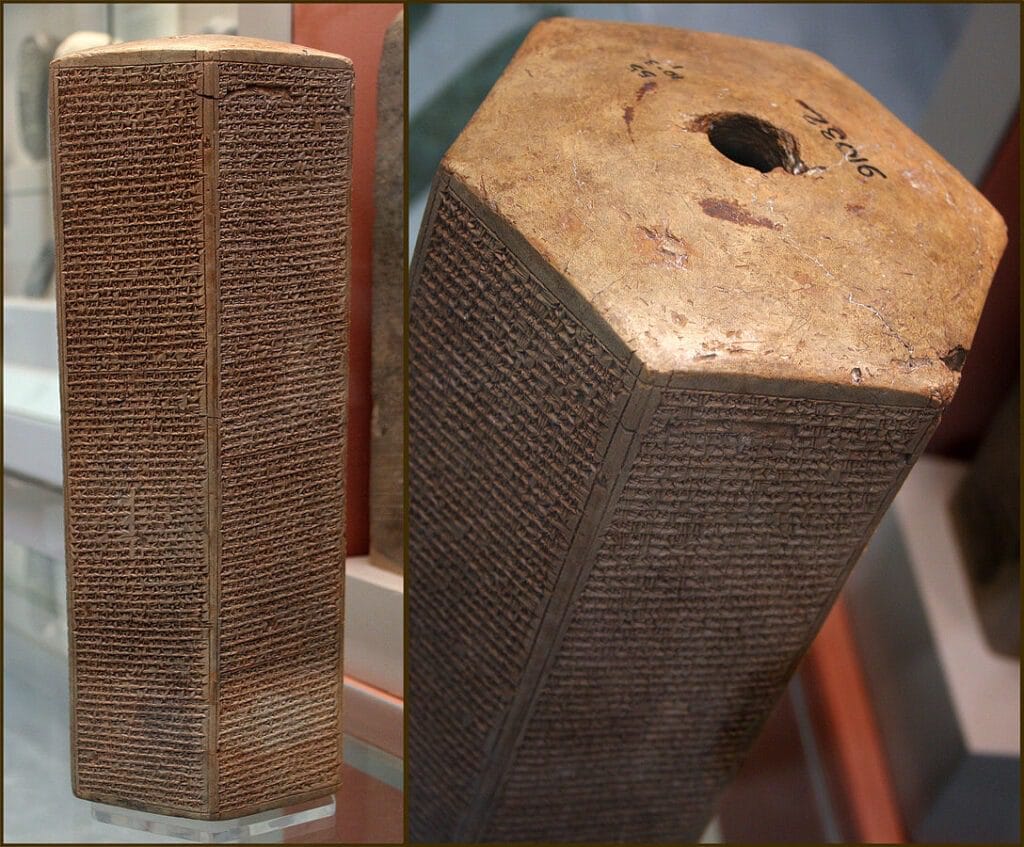
Stone spoke, but clay travelled. Neo-Assyrian royal annals were inscribed on hexagonal and barrel-shaped clay prisms and cylinders, then distributed to temples, provincial capitals, and palace archives simultaneously across the empire. The most famous surviving example is the Sennacherib Prism, of which three near-identical versions survive: the Taylor Prism at the British Museum (discovered 1830), the Oriental Institute Prism at the University of Chicago’s Institute for the Study of Ancient Cultures (purchased by J. H. Breasted in 1919, inventory A2793), and the Jerusalem Prism in the Israel Museum. That three copies existed in three different institutional locations tells us the entire point: no single depository could be the sole custodian of the message.
The phrase these prisms are most remembered for is surgically constructed. Describing the siege of Jerusalem in 701 BCE, Sennacherib records that he confined Hezekiah of Judah in his capital like a bird in a cage. The Akkadian original reads kīma iṣṣū ina kīšišu. The metaphor does exactly the work it is designed to do. It asserts dominance without admitting failure. Jerusalem was never captured. The prism never claims it was. Instead, Hezekiah is trapped, reduced, and humiliated, while 200,150 deportees are itemised with bureaucratic precision. The language transforms a military stalemate into a rhetorical triumph. This is sophisticated message management, not simple royal boasting.
The annals were also multilingual enterprises. The formal royal text ran in Akkadian. But Aramaic, increasingly the everyday lingua franca of the empire from the eighth century BCE onward, carried the same messages in letters, oral recitation, and diplomatic interpretation. When an Assyrian delegate arrived at a foreign court to read out terms, core phrases from the annals were being translated in real time. The repetition across stone, clay, and human voice meant the empire’s self-description was nearly impossible to avoid.
Built out of a love for history, kept free from distractions.
Spoken Past is an independent project shaped by curiosity, care, and long hours of research. Reader support helps keep it maintained, carefully researched, and open to everyone.
Architecture, lamassu, and the body’s encounter with power
Palace reliefs were one layer of a sensory system designed to destabilise visitors before they reached the throne. Approach to any major Assyrian palace began with the lamassu, composite guardian figures carved from single limestone blocks weighing up to thirty tons. The lamassu of Sargon II’s palace at Dur-Sharrukin, modern Khorsabad, excavated by the Oriental Institute of the University of Chicago between 1928 and 1935 under teams led by Edward Chiera and later Henri Frankfort, exemplify both the engineering and the psychology involved. Each has five legs: viewed from the front, the creature stands immovable; viewed from the side, it strides. A single massive sculpture expresses both solidity and motion depending on where you stand. Cuneiform bands at the base invoke divine protection and warn that damage to the image brings divine retribution. The visitor steps over a legal and theological threshold simultaneously.
The interior spaces built on this foundation of controlled unease. Archaeological and textual evidence from Nimrud, Khorsabad, and Nineveh shows that the palace walls in use were not grey stone. Painted plaster filled the gaps. Glazed bricks in turquoise and white gleamed in torch and lamp light, since there were no windows in the conventional sense. Cedar beams from the Lebanese mountains, recorded in tribute lists as a prestige material requiring specific logistical arrangements, perfumed the air. Bronze sheeting covered doorways. The combination of unfamiliar scent, reflected light, and massive scale worked on the nervous system before any formal exchange began.
Routes through the complex were choreographed. Entering guests moved from open courtyard into compressed antechambers before long throne-room corridors opened around them. The narrative on the walls tracked their progress: divine approval of campaigns at the entrance, the technical phases of battle in the middle corridors, submission and tribute near the throne. A visitor who walked from entrance to audience had physically moved through a complete argument about the nature of Assyrian power.
Deportation written in population movement
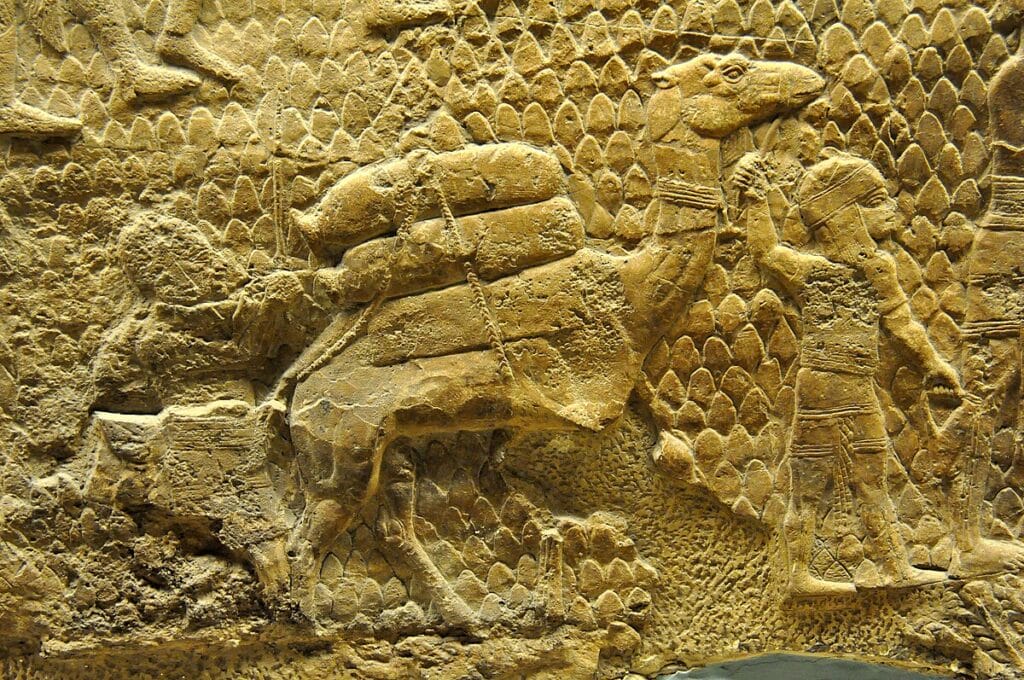
The Lachish reliefs devote as much carved space to the deportation of survivors as to the assault itself. This reflects the centrality of forced resettlement in the Assyrian imperial model. Tiglath-Pileser III, who reigned from 745 to 727 BCE, systematised deportation at a scale no previous Near Eastern empire had attempted, moving populations ranging from tens to hundreds of thousands from a single campaign according to his annals. The Sennacherib Prism claims 200,150 people removed from forty-six fortified cities in Judah during the 701 BCE campaign. Historians treat these numbers cautiously since Assyrian scribes counted for propaganda as much as administration, but the general scale is confirmed by the broader textual and archaeological record across multiple regions.
The visual grammar of deportation in the reliefs is itself propagandistic. Families walk in long orderly files, not chaotic flight. Ox-carts carry household goods. Soldiers march at measured intervals. The ordered depiction is a message: this is policy, systematic, inevitable, perfectly administered. The empire that can displace a city’s entire population without apparent disorder is not an enemy you can outlast through endurance. It is a system you can only join or be destroyed by.
Deportation also carried a domestic audience. Administrative archives from provincial centres, including ration documents and field-assignment records, show that deported communities received barley distributions, work animals, and seed grain on arrival. Terror initiated the process. Bureaucracy sustained it. The empire did not scatter populations randomly. It attempted to reconstruct compliant agricultural communities that would pay taxes and lack the social networks to coordinate resistance. The offer of a usable future after displacement made the initial coercion more credible, not less brutal.
Banquets, hunts, and leisure as political argument
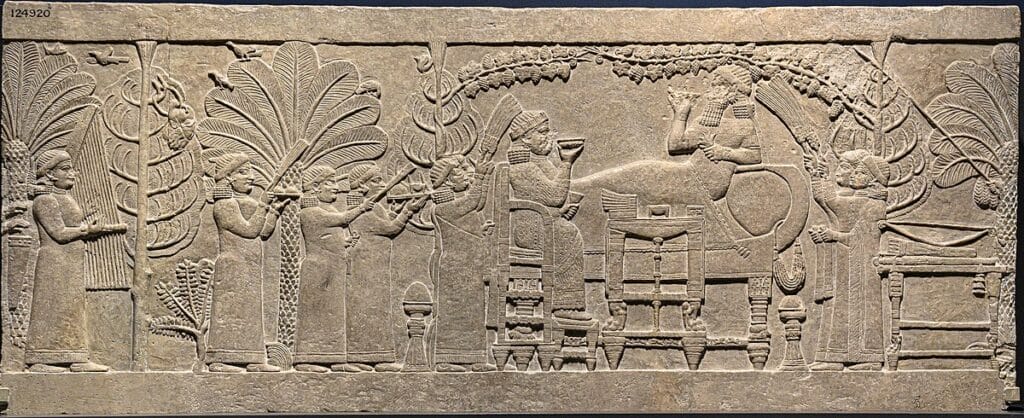
One of the most psychologically intricate images in all of Assyrian art is the Garden Party relief of Ashurbanipal, now in the British Museum (BM 124920). Ashurbanipal, who reigned from approximately 669 to 627 BCE, reclines on a couch beneath a vine arbour. His queen sits on a throne opposite. Musicians play. Attendants fan and serve. From a pine tree to the left hangs a severed human head. It is the head of the Elamite king Te-Umman, defeated at the Battle of the River Ulai around 653 BCE. The composition is deliberate to the point of being sardonic. There is no attempt to obscure the trophy. It is, if anything, framed by the pleasant scene surrounding it. We are comfortable, the image says, because our enemies are destroyed, and we are comfortable enough with that fact to dine beside it.
The lion hunt sequences from the same North Palace at Nineveh work through related logic. Lions charge with genuine ferocity in the carved panels. The king stands calm at the centre of chaos, drawing his bow from horseback or a chariot. Columbia University art historian Zainab Bahrani has explored how Assyrian visual culture constituted violence as a legitimate and divinely sanctioned category of royal activity, meaning the king who hunts lions and the king who destroys cities are performing the same cosmic function. Violence in this framework is not an admission of failure to govern peacefully. It is the governing principle itself.
Tribute procession scenes complete the circuit. Long files of delegates from named foreign peoples, each in distinctive regional dress, carry exotic goods toward the enthroned king. Mesopotamian artists took care to differentiate ethnic markers with precision: beard styles, headgear, robes. A court official or administrative scribe who knew the empire’s geography could read each procession as a catalogue of subject peoples. The king does not move. The world moves toward him. It is the spatial grammar of dominance made visible in stone.
Pre-siege diplomacy and the intelligence behind terror
The reliefs do not capture the systematic advance work that preceded every campaign. Royal archives from Nineveh, now distributed across the British Museum, the Oriental Institute, and the Iraq Museum in Baghdad, preserve letters from provincial governors and intelligence officials detailing troop counts, road conditions, river levels, and the political reliability of local rulers. An army arriving before a city arrived with dossiers. Its commanders knew the water supply, the grain stocks, the names of garrison officers, and which tribal leaders might be persuaded to negotiate.
Assyrian envoys arrived before the army as well. The account in 2 Kings 18 of Sennacherib’s senior official the Rabshakeh addressing the population of Jerusalem directly from the city wall, in Hebrew rather than Aramaic, is plausible within documented Assyrian diplomatic practice. The purpose was to detach the civilian population from its leadership by demonstrating that the empire understood their language and was offering them a personal deal: submit individually and survive, trust your king and suffer collectively. This form of targeted civilian-directed communication, bypassing rulers to speak directly to subjects, is recognisable in any subsequent era of political persuasion.
The manufacturing of the entire ideological apparatus deserves attention as an industrial enterprise. Quarries near Nimrud supplied the gypsum. Sledge teams transported blocks weighing several tons to palace sites. Workshops employed master sculptors who handled faces, hands, and the subtle gradations of rank visible in clothing fringe counts, alongside apprentices carving repetitive elements like soldiers’ beards and battlements. Prism inscriptions required specialist scribes trained in the highly formalised idiom of royal annals. Painters, bronze workers, and cedar carpenters added additional sensory layers. The result was not the product of individual genius. It was an industrial system of ideological production operating simultaneously across multiple palace sites.
When the walls stopped working
The system eventually failed, but not because the propaganda ceased to function. Civil war in the 650s BCE between Ashurbanipal and his brother Shamash-shum-ukin, governor of Babylon, drained the resources and shattered the military momentum that had kept the palace workshops supplied with fresh victories. Without new campaigns to carve, the corridors showed the past rather than an ongoing present. When the Median and Babylonian coalition destroyed Nineveh in 612 BCE and systematically burned and buried the palace complexes, the destruction was thorough precisely because everyone involved understood what those walls represented. The reliefs were not decoration. They were the empire’s argument for its own legitimacy, and when the empire fell, the argument required burial.
Later empires borrowed selectively from the Assyrian template. Achaemenid throne hall reliefs at Persepolis show subject peoples bringing tribute in calm procession, stripped of the gore and execution imagery that defined Assyrian corridors. The message of universal tribute-paying survives, filtered through a different imperial aesthetic. Roman triumphal arches carried the same grammar of the emperor at centre with the world streaming past in submission, but they moved the imagery from restricted palace interiors to public streets accessible to all citizens. That change in venue tells us something essential about Roman civic identity that Assyrian palace culture does not share. But the underlying vocabulary of power through permanent staged imagery runs directly from Nimrud and Nineveh to the Arch of Titus and beyond.
Sources: Irene J. Winter, “Royal Rhetoric and the Development of Historical Narrative in Neo-Assyrian Reliefs,” Studies in Visual Communication 7 (1981): 2–38; Paul Collins, Assyrian Palace Sculptures (British Museum Press, 2008), accessible via the British Museum collection; David Ussishkin, The Renewed Archaeological Excavations at Lachish (1973–1994), Volumes I–V (Tel Aviv University, 2004), described at the Shelby White and Leon Levy Program for Archaeological Publications, Harvard; David Ussishkin, “Excavations at Lachish,” in Expedition Magazine, University of Pennsylvania Museum, archived at penn.museum; Sennacherib Prism (Oriental Institute inventory A2793), collection highlights at the Institute for the Study of Ancient Cultures, University of Chicago; D. D. Luckenbill, The Annals of Sennacherib, Oriental Institute Publications II (Chicago, 1924); Zainab Bahrani, The Graven Image: Representation in Babylonia and Assyria (University of Pennsylvania Press, 2003); Lachish Reliefs, British Museum, BM 1856,0909.14.2.