

The Lex Irnitana is a Roman municipal law engraved on bronze tablets in 91 CE that set rules for local government in the town of Irni in Roman Baetica, making it the most complete surviving copy of the Flavian municipal charter used across provincial municipalities in this period. Found in 1981 near El Saucejo in the province of Seville, six tablets were recovered, five of them complete, revealing detailed procedures for elections, courts, finance, and civic order under Emperor Domitian.
Scholars use this text to reconstruct how municipal institutions worked on the ground, including the roles of the chief magistrates, the council, and city officials in daily administration. The find also confirmed that towns used a standard model law, with the name of each city adapted on bronze copies displayed for public view.
Dimensions and mounting holes show the tablets were meant for wall display at a readable height, which the law itself required so residents could see their rights and duties. Together with related tablets from Malaca and Salpensa, the Lex Irnitana anchors the best evidence for municipal law in the western Empire during 500 BCE to 500 CE. This article explains how the Lex Irnitana was found, how it worked, and why it matters for understanding Roman local government between 500 BCE and 500 CE.
Origin and date
Archaeologists identified the Lex Irnitana as a set of bronze law tablets found at Las Herrizas near El Saucejo, Seville province, in 1981, with five complete tablets and one fragment from a larger ten‑tablet series once mounted for public display. The surviving tablets include numbers III, V, VII, VIII, IX, and X, and later fragments of tablet II were recognized, indicating a nearly continuous text through the end of the law.
The law bears Domitian’s authority and is dated to 91 CE, situating it firmly within the Flavian dynasty’s reorganization of municipal frameworks after Vespasian expanded Latin rights in Hispania. Before the discovery, Irni itself was unknown in ancient texts, and excavations at the findspot suggest the tablets were moved to a bronzesmith’s workshop for melting, probably in the third or fourth century.
The tablets are now in the Museo Arqueológico de Sevilla, where they are treated as a signature object for the province’s Roman legal heritage. In the scholarly literature, the Lex Irnitana quickly became a cornerstone for reconstructing Flavian municipal law across Roman Spain and beyond. Its publication stimulated debate about legal procedures, citizenship pathways, and the relationship between locally elected magistrates and imperial oversight under Domitian.
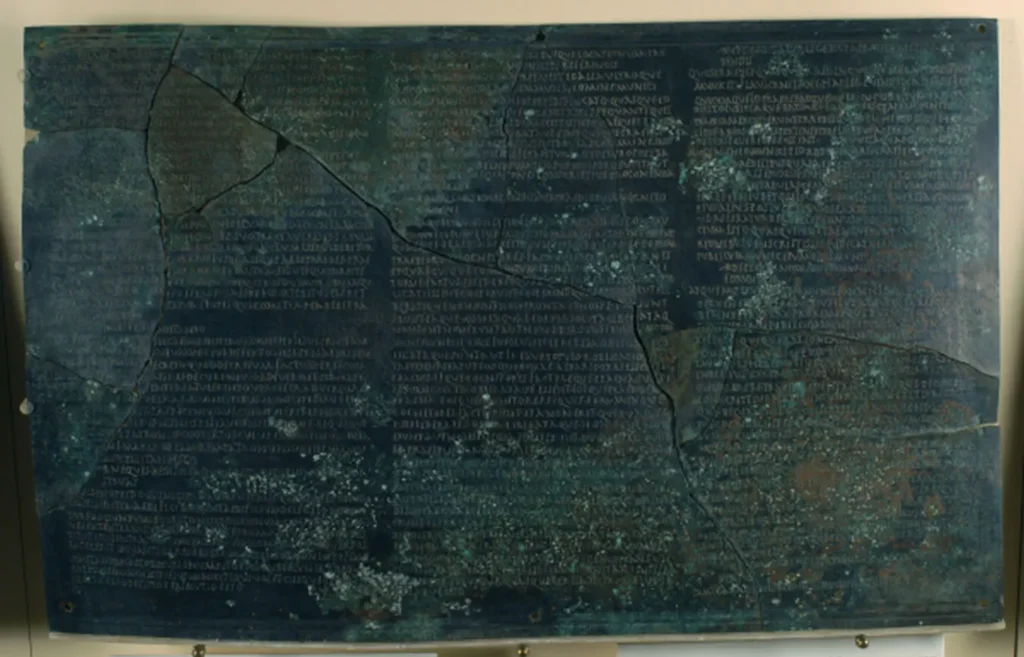
The physical format reinforces the legal purpose, with three columns of small letters framed by molding and holes for fixing the plates to a façade at a mandated reading height set out in chapter 95. When displayed together, the series likely stretched about nine meters, creating a continuous public reference for citizens to consult.
Dimensions recorded by curators give a height of 91.5 cm and width of 57.5 cm per tablet, typical for large civic inscriptions meant to be legible in a forum setting. The sequence ends with a legal sanctio on tablet X, a standard clause that confirmed penalties and enforcement and marked the conclusion of the inscription.
Because the text includes an imperial subscript connected with Domitian, the engraving is understood to be contemporary with his reign rather than a later copy. The tablets’ survival in Baetica aligns with Hispania’s role as an early laboratory for Roman municipal governance and epigraphic display on bronze. Their completeness relative to other cities made Irni’s law the primary comparative base, relegating Malaca and Salpensa copies to supporting roles for reconstructing missing parts.
In museum terms, the tablets remain a focal point for explaining how Roman law was displayed and read in provincial centers, and they are regularly cited as flagship pieces in the Seville collection. The tablets are exhibited in the Museo Arqueológico de Sevilla, connecting the surviving bronze to the city’s broader narrative of Roman administration in Baetica.
Curatorial notes emphasize that the text was standardized across municipalities, with Irni’s name inserted where required for local identification. That standard format explains the close textual overlaps among Irni, Malaca, and Salpensa, and it allows scholars to use one copy to fill gaps in another where chapters align.
The exhibition context also highlights the tablets’ destruction risk, since many such bronzes were recycled, which explains why a complete sequence is rare. The Irni bronzes thus preserve a near-unique window into municipal lawmaking and publication practices at the city level in the first century CE. They also frame later scholarly debates about how far local consent could shape jurisdiction and procedure within a municipal charter.
How the Lex Irnitana worked
The Lex Irnitana is a municipal charter, meaning a standard legal template that defined a municipium, which is a self-governing city with local citizenship and institutions under Roman oversight, adapted for local use at Irni. It set out the powers of key magistrates, including the duumviri who presided over courts and administration, the aediles who handled markets and public order, and the quaestores who managed the treasury and payments.
It also regulated the ordo decurionum, or city council of local notables, establishing eligibility, attendance, and procedures for municipal decision-making. The charter described how assemblies convened, in what order speakers could address the body, and how motions became enforceable rules at the city level.
It enumerated permitted expenditures from the public purse and set remuneration rules for municipal workers, which created predictable fiscal routines. The text governed manumission and guardianship, areas of private law administered locally, and it specified paths for local magistrates to gain Roman civil rights through service. By defining roles and procedures in one place, the charter reduced disputes and standardized administrative practice across similar towns.
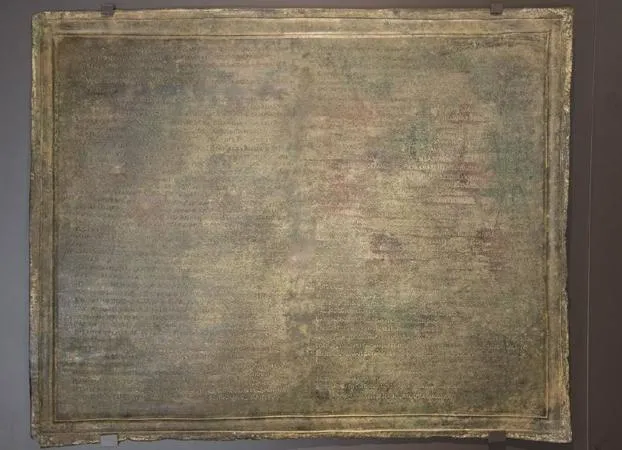
The election rules in chapters 52 to 55 guided the annual appointment of magistrates and specified candidate requirements and voting mechanics that resemble modern polling procedures in their clarity and sequencing. Procedures for appointing judges and ordering pleadings appear in multiple chapters, giving a rare, practical view of civil proceedings under local jurisdiction.
A central scholarly question concerns chapter 84 on jurisdiction, which some read as allowing parties to consent to try substantial cases locally, extending beyond small-claim limits. Legal analysis suggests that parts of chapter 84 suffered redaction errors and early misrestoration in print editions, which complicates interpretation and fuels ongoing debate in Roman legal history.
That debate matters because consent to jurisdiction was a major reform in Augustan and early imperial procedure, and the Irni charter preserves the best epigraphic clue in a municipal context. The law’s procedural chapters therefore bridge municipal practice and broader imperial legal reforms through concrete, operational clauses rather than abstract principles. For researchers, these lines explain how cases moved, who presided, and how decisions were enforced in a provincial town.
Citizenship provisions fit a common Flavian pattern, granting Roman citizenship to local officeholders after completing magistracies, which tied civic service to inclusion in the wider empire’s legal community. Marriage rules retained prohibitions on mixed marriages between Romans and non-Romans at the time, with specific dispensations for unions made before the law, which reflects both boundary setting and pragmatic grandfathering of existing households.
The charter also regulated cult funding, priesthoods, ritual calendars, and civic games, treating religion as a public matter with budget lines and office duties. By setting expense categories and approval rules, the law limited ad hoc spending and defined when honors and rituals could draw on public funds.
The patron–client relationship appears in the text in rules that mediated obligations and formal recognition at the municipal level, anchoring social ties to legal processes. Because the template was standard, similar chapters appear in Malaca and Salpensa, which allows cross-checks where Irni’s text is worn or incomplete. These overlaps are the reason modern editors correlating the three sets can reconstruct most of the intended chapter sequence and content.
The legal text ends with a sanctio, a penalty and enforcement clause common in Roman statutes that confirms the law’s force and consequences for violations. The final tablet also includes an imperial document associated with Domitian, often called a letter or subscript, tied to municipal marital rights and interpreted through diplomatic analysis rather than narrative history.
Scholars argue this imperial piece was prompted either by an embassy seeking a dispensation or by a legal ambiguity raised during a provincial proceeding, both standard channels for imperial responses. Its presence on the bronze shows how municipal charters could incorporate later authoritative clarifications within the displayed text.
That integration emphasizes the public nature of law in Roman towns, where updates were visible alongside core rules. These features together make the Irni tablets exceptional teaching tools for Roman law in practice. Debates in the Journal of Roman Studies continue to refine readings and restorations that affect how historians understand local jurisdiction.
Built out of a love for history, kept free from distractions.
Spoken Past is an independent project shaped by curiosity, care, and long hours of research. Reader support helps keep it maintained, carefully researched, and open to everyone.
Why the tablets matter
The Lex Irnitana is the fullest municipal charter preserved from the Roman world, so it anchors discussions of how towns ran elections, courts, finances, and religion under a single legal template. Because Irni was unknown before the find, the tablets also expand the map of Roman municipal life in Baetica and show how a new community can enter history through epigraphic evidence.
The completeness of multiple tablets provides a baseline for editing fragmentary municipal laws elsewhere and for testing claims about provincial standardization. For historians of administration, the text shows cause and effect between written rules and repeatable practice, since it binds officeholders to procedures for meetings, spending, and adjudication.
For legal historians, chapters on procedure and jurisdiction offer the best municipal window into classical-era civil process, including consent to jurisdiction and judge appointment. For social history, provisions on citizenship and manumission illustrate how local status could translate into wider legal inclusion.
The tablets thus serve multiple research angles without drifting from a single object and law as the focus.
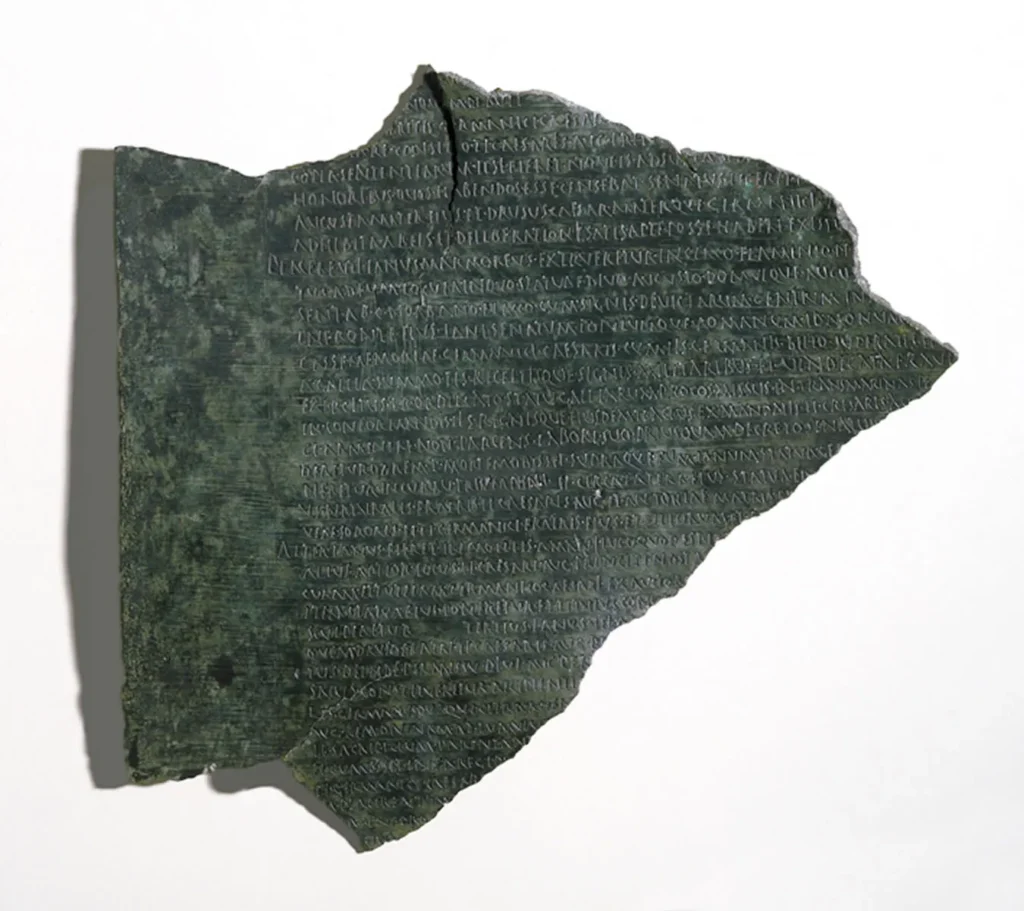
The charter’s standardization is clear from close parallels with the Lex Malacitana and Lex Salpensana, which preserve overlapping chapters and confirm a common Flavian municipal model with town names swapped on local copies. The Malaca and Salpensa tablets, housed in Madrid, fill gaps where Irni’s text is damaged, and Irni fills theirs, allowing editors to restore a coherent sequence of rubrics across the three cities.
Measurements and mounting features on all these bronzes, plus explicit language in chapter 95, confirm they were meant to be read by citizens rather than kept in archives. That visibility linked municipal law to civic identity, since residents could see election steps, spending rules, and rights listed in the forum.
The pairing of legal uniformity with local display helped the empire scale municipal governance while letting each town speak its own name on the law. For modern institutions, these objects demonstrate how public posting and consistent templates build trust and predictability in local government. Objects at the National Archaeological Museum illustrate this network of municipal texts and their role in shaping civic life across Baetica.
Frequently Asked Questions
What is a municipium in Roman law?
A municipium was a self-governing city with local institutions and a civic body under Roman authority, often with defined rights and duties laid out in a municipal charter like the Lex Irnitana.
Who were the duumviri named in the charter?
The duumviri were the two chief magistrates of a municipium who presided over courts and administration, as specified in the municipal law’s chapters on office competencies.
Why is chapter 84 of the Lex Irnitana debated?
Chapter 84 concerns jurisdiction and whether parties could consent to try higher‑value cases locally, and scholars argue parts were misordered or misrestored in early editions, which changes the rule’s meaning.
How were elections conducted under the law?
Chapters 52 to 55 laid out candidate qualifications, voting order, and appointment procedures for magistrates in an annual cycle described with unusual procedural detail for an inscription.
Did the law grant Roman citizenship to locals?
Yes, it provided that those who held certain municipal magistracies could obtain Roman citizenship, aligning local service with imperial legal integration.
Where can the tablets be seen today?
The Irni tablets are held by the Museo Arqueológico de Sevilla, with related municipal tablets from Malaca and Salpensa curated at the National Archaeological Museum in Madrid.
Why were the tablets displayed on walls?
Mounting holes and chapter 95’s instruction show the law had to be posted at a set height for easy reading, linking public display to transparency in civic rules.
How does the Lex Irnitana relate to the Lex Malacitana and Lex Salpensana?
All three are copies of a Flavian municipal model, sharing chapters and structure so editors can use one to reconstruct losses in another.
What is a sanctio in Roman statutes?
A sanctio is the concluding enforcement clause that states penalties and confirms the binding force of the law, closing the text on the final tablet.
Why is Irni important if it was unknown before 1981?
The tablets add a new municipality to the historical record and, because they are so complete, they shape how historians read municipal law across Hispania.
Further reading
Museo Arqueológico de Sevilla Lex Irnitana object page: Official collection record with dimensions, provenance, and curatorial summary of content and significance.
Journal of Roman Studies article on the Lex Irnitana: Foundational scholarly study situating the tablets within Flavian municipal law and Roman legal history.
CERES MAN Tabla Salpensana object page: National museum record for a parallel municipal tablet used to correlate chapters and restore the common model.