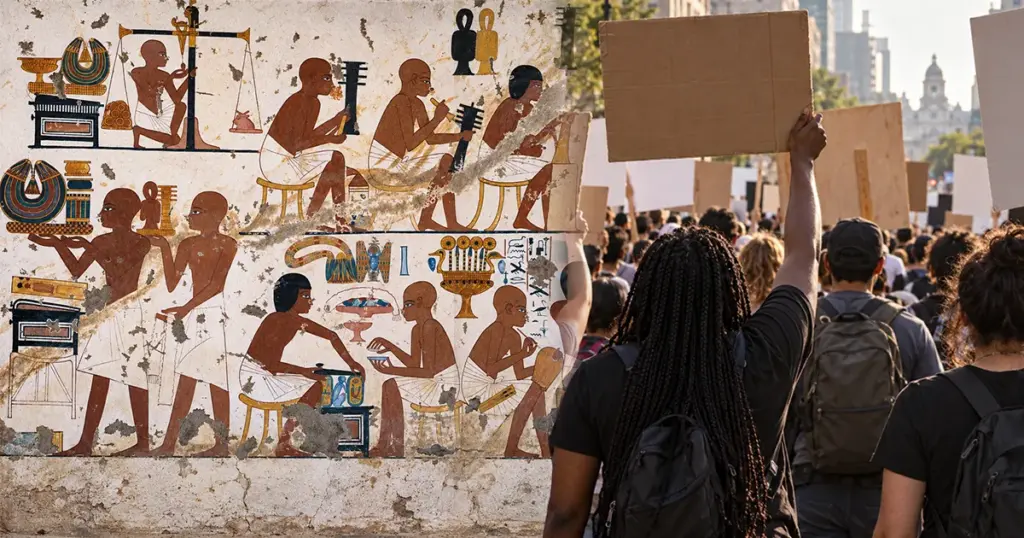
In the twenty-ninth year of Ramesses III’s reign, in the 1150s BCE, the royal tomb workers of Deir el-Medina left their work area and sat down behind a temple at Thebes. Their grain payments had failed to arrive, and their households were short of necessities. Officials came to persuade them to return. The workers wanted the provisions they were owed.
The dispute produced a series of stoppages, sit-ins and negotiations over roughly three months. A contemporary papyrus records their movements between royal temples, the complaints they made and the deliveries officials arranged. Usually described as the first recorded strike, the episode survives in unusual detail. Its participants were skilled craftsmen employed on the pharaoh’s tomb, with foremen, scribes and police officers between them and the authorities responsible for their pay. They expected those authorities to feed them, and repeatedly stopped work when that expectation was not met.
The Craftsmen Who Built the Royal Tombs
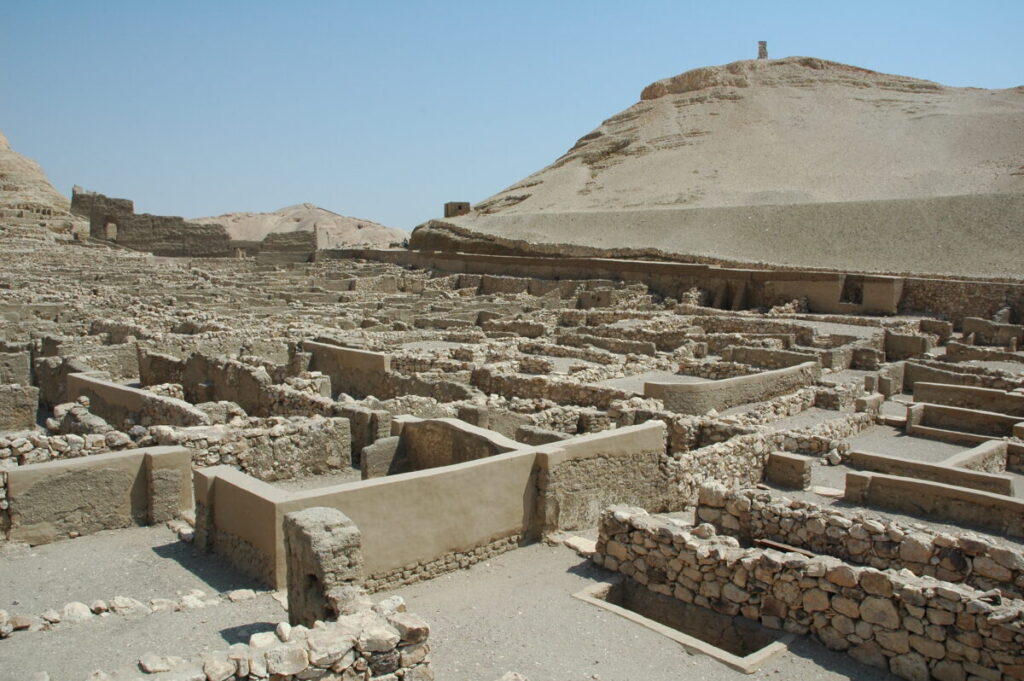
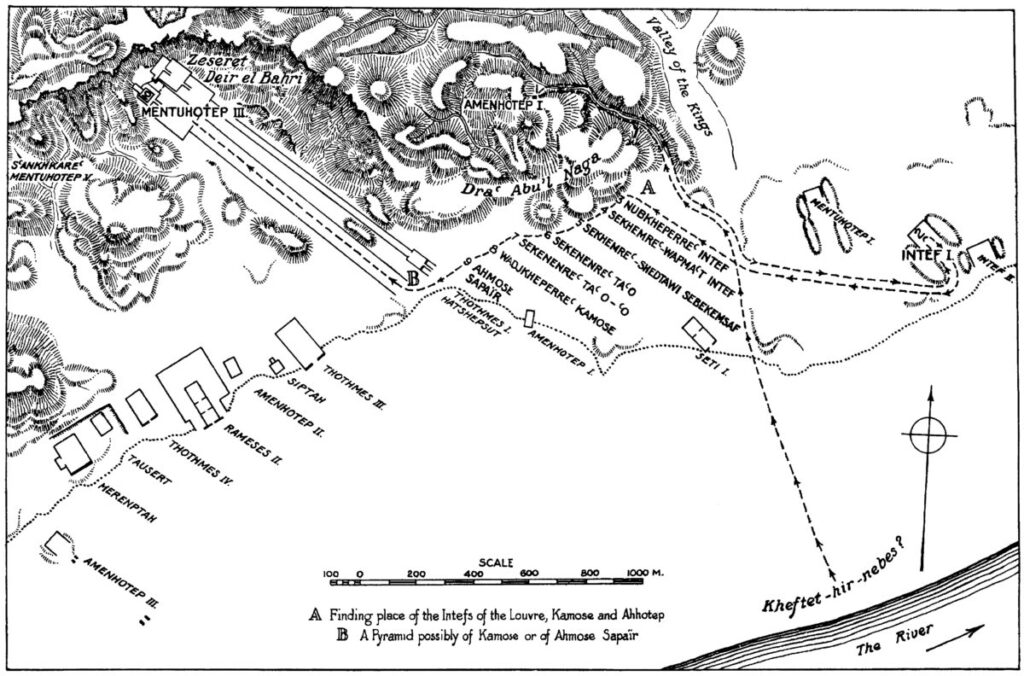
Deir el-Medina lay in a desert valley on the west bank of the Nile, opposite Thebes, near modern Luxor. Its inhabitants worked in the royal necropolis, the extensive burial area that included the Valley of the Kings. Stonecutters excavated tomb chambers and corridors, while other craftsmen prepared, carved and painted their surfaces. The community also included carpenters and other specialists whose skills served the royal burial establishment. These were New Kingdom tomb builders, living more than a thousand years after the construction of the Great Pyramid.
Their village stood away from the cultivated land that supplied much of Egypt’s food. Deliveries supported the craftsmen and their households, allowing the men to devote their working time to the tombs. Water carriers and other service personnel helped sustain the settlement. As Jaana Toivari-Viitala explains in her study of Deir el-Medina’s development, its residential community belonged to a larger organization of workplaces, officials and suppliers. A failure in that organization could leave people in the village without goods that were available elsewhere.
The workforce was divided into two sides, each with its own foreman. Scribes kept records, deputies assisted the senior men, and guards controlled access to the necropolis. Above the village administration stood the vizier, one of Egypt’s highest officials. Workers knew whom to approach when deliveries failed, but the number of people involved also meant that a complaint could pass through several hands before anyone supplied grain.
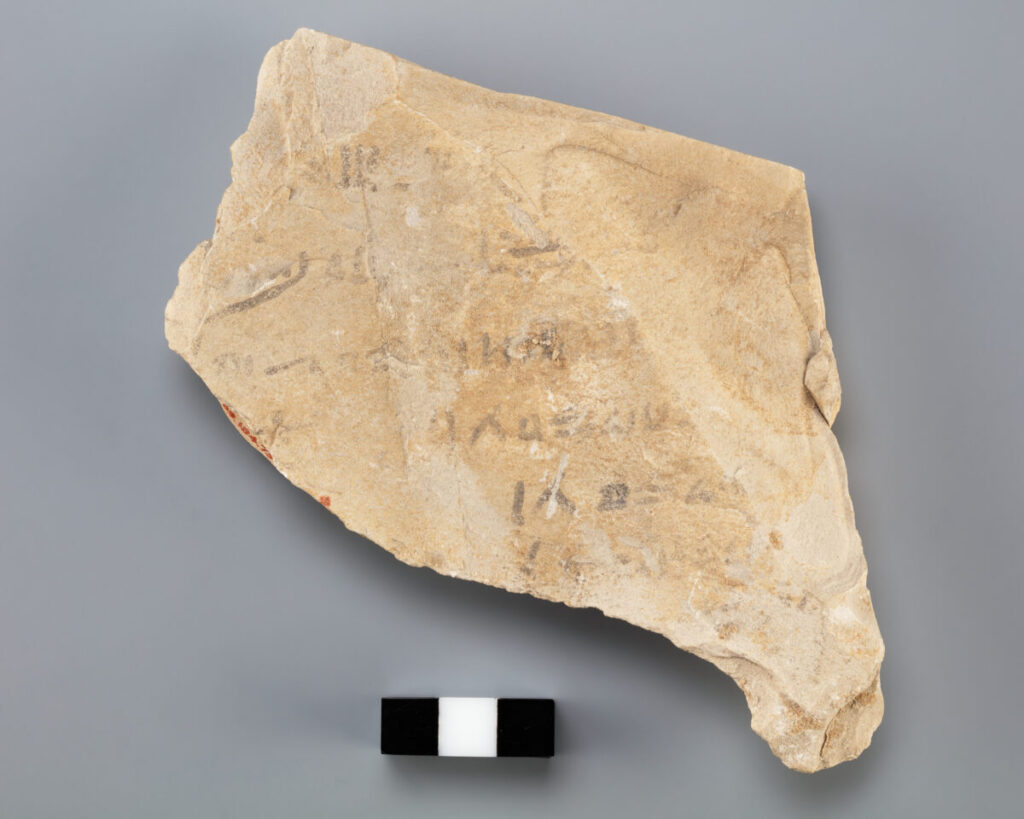
Much of this working life survives in writing. Papyrus documents and ostraca, pieces of pottery or limestone used as writing surfaces, preserve accounts, letters, absences and disputes. The Strike Papyrus in Turin’s Museo Egizio, catalogued as Cat. 1880, belongs to this administrative world. The museum attributes it to the scribe Amennakht. Written in hieratic, the cursive script used for much Egyptian recordkeeping, it contains protest reports alongside deliveries and other village business. The workers’ statements reach us through a scribe’s selection and wording, rather than a complete record of everything said.
How the Pharaoh Paid His Tomb Builders
The workers received much of their remuneration in grain. Calling these payments “rations” can make them sound like meals handed out at a work site, but they supported households and formed part of what the men received for their labor. In her 2016 study of the Egyptian ration system, Hana Vymazalová gives the usual monthly allocation for an ordinary Deir el-Medina workman as four sacks of emmer wheat and one and a half sacks of barley. Senior personnel received different quantities, reflecting their positions within the workforce.
Grain could be processed for food, stored or exchanged. A missed delivery therefore affected both the household’s immediate supplies and the resources available for meeting other obligations. The village’s household accounts and records of exchanges show workers lending, owing and transferring goods among themselves. Official employment existed alongside these private dealings. Regular pay helped a household manage them; repeated delays made that harder.
Grain was also only one part of the provisioning system. Fish, vegetables, oil and clothing appear in the workers’ complaints, while the settlement depended on deliveries of water and fuel. The craftsmen were employed to perform specialized work for the king. They could reasonably expect the administration that required their labor to provide the supplies attached to it. When those supplies stopped arriving, the dispute concerned an obligation the workers believed had already been established.
Missing Grain and the First Walkout
The shortage had begun before the best-known protest. An ostracon now in Berlin records an earlier complaint in the same regnal year. Amennakht appealed for grain, and supplies subsequently came from the temple of Horemheb. Egyptologist Jenny Cromwell discusses this document alongside the strike in her account of the surviving evidence. The earlier intervention secured provisions, but it had not produced reliable deliveries by the time the workers walked out again.
The main episode begins on day 10 of the second month of Peret, the Egyptian growing season, in year 29. The opening entry of the Turin Strike Papyrus describes the crew passing five guard posts and sitting behind the mortuary temple of Thutmose III. Their stated complaint was hunger. Leaving the controlled work area and gathering at a royal temple brought the dispute beyond the men’s ordinary working routine and demanded a response from officials.
The scribe, foremen, deputies and other supervisors came to call them back. They invoked the business of the pharaoh, whose tomb the men were supposed to be serving. The workers’ dependence on royal provisions now obstructed that royal work. An instruction to return could not by itself replace the grain that had failed to arrive.
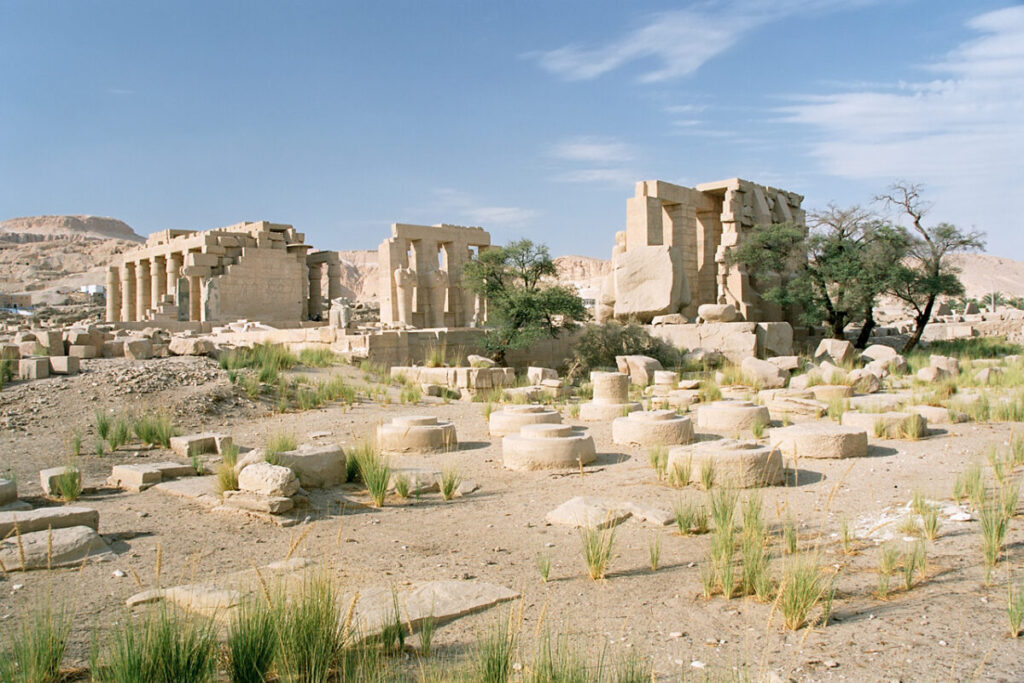
On the following day the men moved toward the temple of Ramesses II, now generally known as the Ramesseum. A separate entry records a delivery of cakes. By day 12 they were again at Ramesses II’s temple, where officials heard a fuller account of their grievances. Food had been supplied during the protest, but a small delivery had not settled the wider problem of overdue pay and missing necessities.
Demands at the Royal Temples
The workers told the assembled officials that hunger and thirst had brought them there. They lacked clothing, oil, fish and vegetables. They asked for their situation to be reported to the pharaoh and the vizier so that provisions would be supplied. The list makes their circumstances more specific than a general complaint about poor treatment: several elements of the system supporting the community were failing at once.
Their appeal still described the pharaoh as their good lord. The workers presented themselves as people whose service entitled them to support from the royal administration. They wanted senior authority brought to bear on a local failure. The papyrus records no demand to remove Ramesses III or abandon royal tomb construction, and no personal meeting between the king and the protesting men.
On day 12 the grain payment for the previous month was issued. This was a substantial response to their demand, and the timing connects it closely with the protest. It also demonstrates how far behind the administration had fallen: the payment belonged to the preceding month. Delivering it relieved an immediate grievance without establishing that future supplies would arrive when expected.
The following day, the chief of police Mentmose proposed taking the men, their wives and their children to the temple of Seti I. He told them to gather their belongings and close their houses before he led them there. His proposal acknowledged that the shortage affected families as well as the employed men. It also shows a police officer participating in efforts to secure a response, rather than simply ordering the workforce back. The surviving entry records what he proposed; it does not establish that the whole community carried out that march.
The temples were familiar institutions within the workers’ world. They maintained royal cults and belonged to the network through which resources and authority operated on the west bank. The men gathered at places associated with Thutmose III, Ramesses II and, later, Merneptah. Their repeated choice of these locations made their complaints accessible to officials outside the immediate village hierarchy. They were seeking provisions within the same royal establishment that employed them.
Why Payments Did Not End the Dispute
A further distribution appears on day 17. The papyrus distinguishes allocations for different ranks and groups, continuing the ordinary administrative practice of recording who was entitled to receive what. These entries show officials arranging supplies while the dispute continued. The workforce was not simply left without any response, but successive deliveries failed to restore a dependable routine.
In the next month, more men passed the guard posts. One workman, Mose, made an oath threatening to prepare to rob a tomb if he was removed from where he had taken his stand. The threat was serious in a community employed to construct and protect royal burials. It remains a threat recorded in the dispute, rather than proof that Mose subsequently carried out a robbery. Other workers, Qenna and Hay, said that they had a complaint about wrongdoing in the royal establishment beyond their immediate hunger.
Their statements widened the dispute to include conduct within the administration. They did not, however, explain every missing delivery. The papyrus preserves accusations and grievances from named individuals, not an investigation demonstrating that one official had stolen the entire grain payment. Misconduct, shortages and difficulties distributing provisions could overlap, but the surviving reports do not reduce them to a single cause.
There is evidence that delivery problems recurred more widely at Deir el-Medina. Jean-Christophe Antoine’s 2009 statistical study of grain-ration delays argues that seasonal fluctuations help explain their pattern. The year-29 strike therefore belongs within a longer history of difficulties supplying the workforce. The workers’ need for regular food continued regardless of the agricultural calendar or the administration’s ability to deliver on time.
Royal demands also continued. The papyrus mentions the vizier To traveling in connection with preparations for the king’s Sed festival, a jubilee celebrating and renewing royal power. A message attributed to him declared that the granaries were empty and that he would provide what he could find. A half-ration was then announced. Festival preparations and the workers’ arrears occupied the same administration, but this passage does not demonstrate that jubilee spending alone caused the shortage. Nor does the vizier’s reported explanation establish that every granary in Egypt was empty.
Scribes and Officials on Both Sides of the Dispute
The workers dealt with officials whose responsibilities did not always produce the same response. Mentmose offered to lead them and their families to a temple. Foremen could encourage complaints to higher authority. Scribes recorded demands and distributed grain, but they also had to keep the royal workforce operating. Schafik Allam’s study of Deir el-Medina’s village superiors describes their role as intermediaries, including efforts to reconcile workers with authorities. The papyrus shows how difficult that position could become.
Amennakht’s actions are particularly revealing. Earlier, he had sought grain for the men, and his records preserve much of what is known about their grievances. Later, after a payment in the first month of Shemu, the harvest season, the foreman Khonsu urged the crew to accept the grain and take their complaint down toward the riverbank, where it could reach the vizier’s circle. The men began to go, but Amennakht stopped them after they passed a guard post. He insisted that he had just distributed grain and threatened legal proceedings if they continued.
The scribe could recognize their need and still oppose their next action. A delivery gave him grounds to demand a return to the established routine; the workers and their foreman evidently considered that their complaint remained unresolved. His response helps explain the repeated negotiations. Each distribution raised the question of whether enough had been supplied to require the men to resume their duties, while renewed shortages gave them reason to leave again.
The men relied on collective action to carry their complaints beyond the work site. Their supervisors relied on persuasion, their authority over the crew and, at times, threats of punishment to bring them back. The record contains no formal union or negotiated set of new labor rights. It does show workers using a shared refusal to continue as a means of pressing an existing claim to payment.
Did the Workers Get What They Wanted?
On day 13 of the first month of Shemu, the crew again crossed the guard posts and sat behind the temple of Merneptah. They called out to the mayor of Thebes as he passed. A message delivered through a gardener promised fifty sacks of emmer to support them until the pharaoh’s rations arrived. Even after earlier distributions and attempts to restrain them, the workers were still trying to obtain food by approaching an official outside the village.
The fifty sacks were an offer. This entry does not record their receipt, and the papyrus gives no conclusive settlement ending the whole sequence. Some earlier payments are explicitly recorded, including the overdue grain issued during the first temple protests. The workers therefore secured practical responses, but shortages and renewed action followed. Their success was uneven and immediate, measured in deliveries that allowed households to continue rather than a lasting change in the terms of employment.
The surviving dates cover separate episodes over roughly three months. They do not establish an uninterrupted stoppage of that length. Nor does the document record a permanent pay increase or a general royal decree protecting strikes. The men repeatedly obtained the attention of officials, and at least some of the provisions they demanded. They remained dependent on an administration whose deliveries had already proved unreliable.
Was This the First Recorded Strike?
The Deir el-Medina episode is widely called the first recorded strike because the evidence identifies the workforce, its grievance, the stoppages and the authorities’ responses. The Turin papyrus allows historians to follow named people through a sequence of dated actions. That detail makes the dispute far easier to reconstruct than a brief reference to workers leaving their posts. It does not establish that no earlier workforce ever acted collectively over its treatment.
There may also be earlier Egyptian documentary evidence. In his 2012 paper, A Strike in the Reign of Merenptah?, Hans-Werner Fischer-Elfert examined fragmentary papyri in Berlin. He proposed reconstructing a phrase about passing guard posts, familiar from later strike records, and connected the material with Merneptah’s reign, before that of Ramesses III. The question mark in his title reflects the condition of the evidence. The fragments lack an unambiguous account of overdue grain and other details needed to establish a comparable dispute securely.
Ramesses III’s workers left a much fuller account. Their record describes hungry households, officials searching for grain, men refusing to return and supervisors trying to recover control of the crew. Royal tomb construction depended on those craftsmen, and the craftsmen depended on provisions organized in the king’s name. When deliveries failed, they used that relationship to press their claim. Payments followed some of their protests, but the recurring walkouts show how often the same obligation had to be asserted again.