
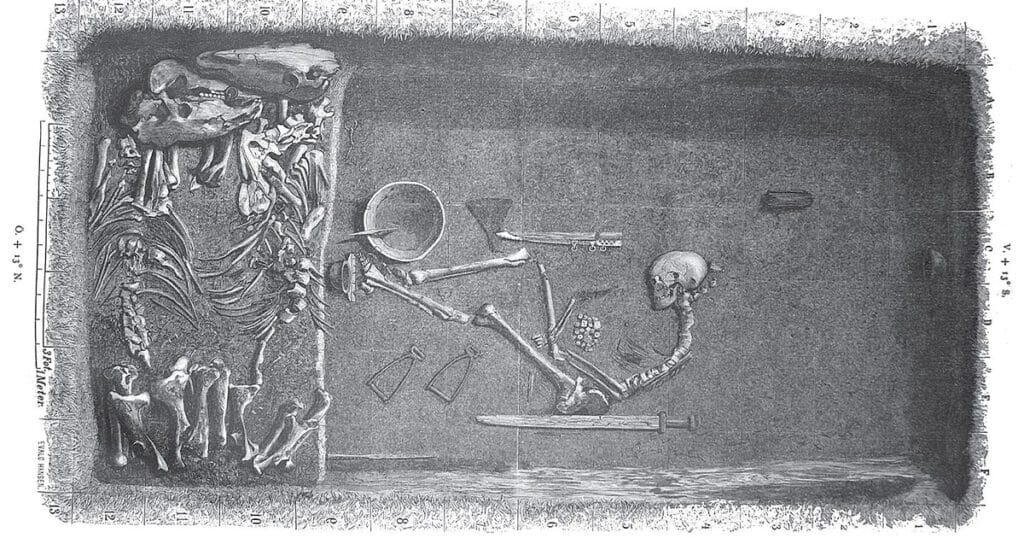
When Hjalmar Stolpe excavated grave Bj 581 at Birka in 1878, the objects looked to him like the equipment of a high-ranking Viking warrior. A sword, an axe, a fighting knife, two lances, shields and numerous arrows accompanied the body. Two horses had also been buried there. Stolpe and generations of later scholars described the person in the chamber as a man, largely because of the character of the grave goods.
Later examination of the skeleton challenged that description. Osteologists observed characteristics associated with female remains, and genomic research published in 2017 identified the buried individual as biologically female. Bj 581 was already one of the best-known examples of an elite Viking warrior grave, prompting scholars to re-examine a familiar interpretation. The objects and Stolpe’s record had not changed. The question was how to interpret a burial whose occupant did not have the biological sex long assumed from its weapons.
Ancient DNA can provide strong evidence about the biological sex of sampled remains. It cannot tell us what work a person performed, how they understood their own gender, whether they had fought, or what authority they exercised in war. The proposal that Bj 581 held a professional warrior rests on the grave’s archaeological context as well as the genetic result. The grave, the original excavation records and Birka’s wider burial landscape explain both the strength of that proposal and its limits.
Birka, the trading town and its hillfort
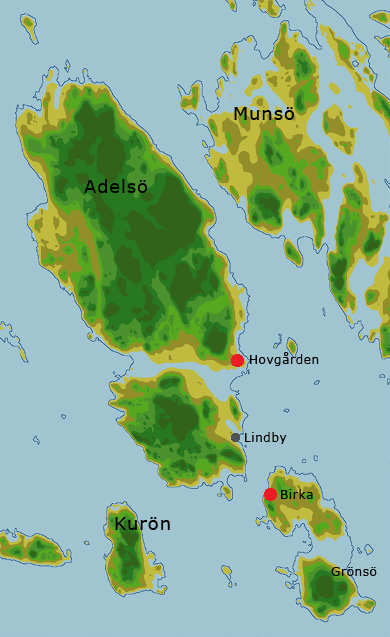
Birka stood on Björkö island in Lake Mälaren, west of modern Stockholm. Founded around AD 750, it became a major trading town of Viking Age Scandinavia. The harbour and its adjoining workshops and commercial quarters connected Swedish inland communities to traffic across the Baltic and towards eastern Europe. Imported objects and changing fashions reflect the many networks in which Birka’s inhabitants participated.
Estimates suggest that Birka’s population numbered several hundred, perhaps 700 to 1,000 at particular times. It was a substantial trading community rather than a modern city. A rampart defended much of the occupied area and a hillfort overlooked the settlement’s southern end. The defences show the importance of security at a trading centre handling valuable goods, although they reveal little about its military organisation.
Extensive cemeteries spread around Birka. Approximately 3,000 graves can be seen or have been recorded, with roughly 1,100 excavated during the nineteenth century. Funerary customs varied: some people were cremated, while others received earth burials or wooden chambers furnished with different combinations of dress fittings, imported items, implements and weapons. What mourners placed in a grave reflected their choices and social conventions. The objects in Bj 581 must therefore be considered as part of a funeral, shaped by the choices of those who arranged it.
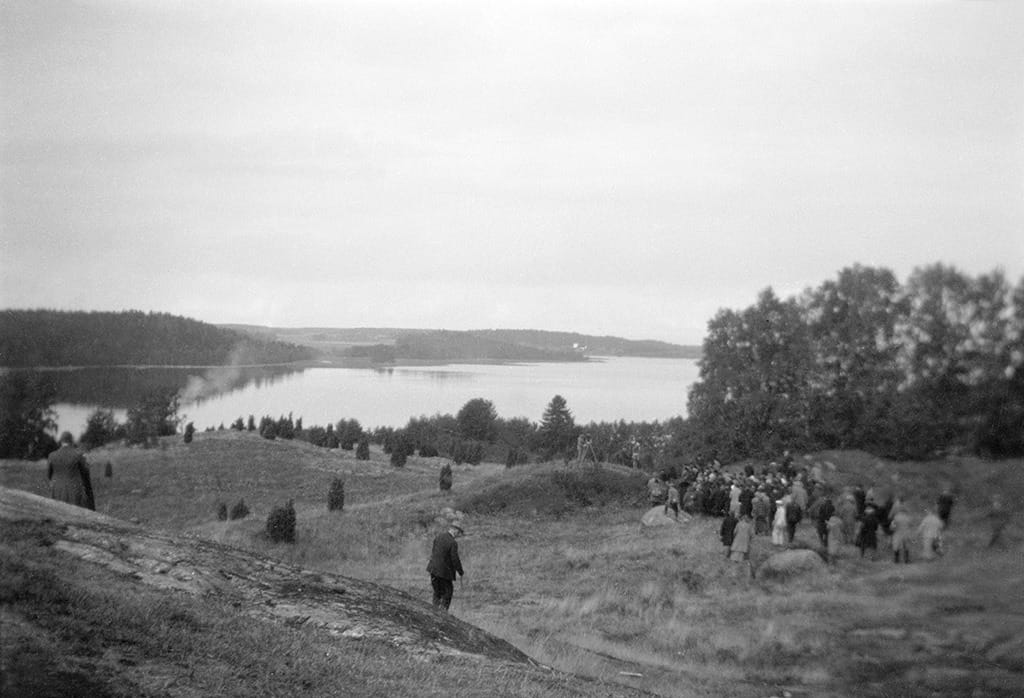
The 2019 review published in Antiquity places Bj 581 on a raised terrace just beyond the hillfort’s northern gate, near the descent towards the town. It occupied the western part of the cemetery landscape and had originally been marked by a large boulder. Weapons were found in nearby graves as well. In 1998, archaeologists excavated a large hall-like structure associated with the site’s so-called garrison, containing an unusually high concentration of military equipment. The location strengthens the burial’s martial associations, though it cannot establish the individual’s service or rank.
What Stolpe found in grave Bj 581
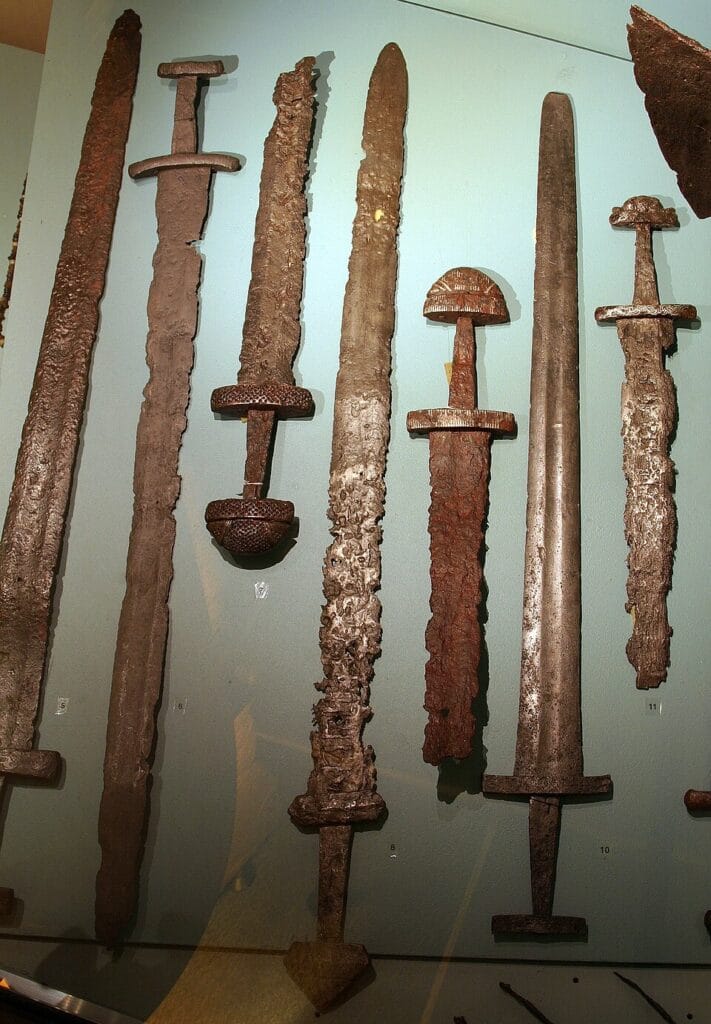
Stolpe’s plans recorded a wooden burial chamber below ground, with the body inside and two horses on a platform at the edge. The animals were identified as a mare and a stallion; one had riding equipment. The inventory was unusually rich. The later researchers catalogued a sword, an axe, a fighting knife, two lances, two shields and 25 armour-piercing arrows. Iron and other metal fittings survived more readily than clothing, straps, weapon shafts and the chamber’s timber, so some details of the original arrangement have disappeared.
The chamber also contained a gaming board beside the body and gaming pieces kept in a bag on the deceased’s lap. Stolpe recorded where they lay, making them part of the identifiable funerary arrangement rather than stray finds without context. Their recorded positions are important evidence for why gaming equipment was placed in this grave. The excavation notes are especially valuable because the original chamber was dismantled more than a century before ancient DNA could be extracted from the remains.
Such an extensive collection of weapons was exceptional at Birka. The 2019 reassessment reports that among more than 1,100 excavated burials, only 75 contained an offensive weapon. Bj 581 was one of just two graves with the full range of weapons and belonged among the twenty richest burials. Researchers interpreted the equipment as belonging to an elite fighting person, perhaps one able to fight on horseback and use weapons for both close combat and attacks at a distance.
The funeral’s intended message may not reflect every part of the buried person’s life. A valuable sword could communicate inherited standing, membership of an armed household, individual achievement or a family’s aspirations. A complete collection of weapons strengthens the impression of a martial identity, but the items were placed there by people arranging a funeral. Their presence cannot independently demonstrate that the deceased fought battles, instructed soldiers or commanded an expedition.
The clothing fittings provide further evidence about how status was displayed. Scholars have compared them with fashions known from the Eurasian steppe and eastern trading connections. A tasselled cap decorated with silver fittings has been interpreted as indicating elevated status. Textile specialists previously suggested an association with cavalry command, an argument considered in the 2019 archaeological reassessment. Such parallels may help interpret how the deceased was presented, but they do not identify a particular military office or prove the clothing was an official uniform.
Why the grave was assumed to contain a man
Stolpe’s attribution was shaped by conventions common in early archaeology. Weapons were treated as signs of a male burial, while jewellery, brooches and implements used in textile work often prompted a female classification. Bj 581 lacked the expected combination of objects associated with women’s graves. Published as a male warrior’s grave, Bj 581 remained a standard example in Viking histories for decades, even as the skeleton received little renewed attention.
The reasoning was circular. Researchers assigned a male sex because weapons were present, then cited the presumed male occupant to reinforce the idea that such weapons belonged to male warriors. Weapons may indicate a military identity; they cannot determine the biological sex of the buried person. Bj 581 exposed how a long-standing expectation had come to function as evidence for the very conclusion it assumed.
Doubts about the earlier identification predated the genetic study. Examination in the 1970s had suggested female skeletal characteristics, but questions continued about whether those bones definitely came from the famous chamber. Anna Kjellström later re-examined the material and drew attention to the inconsistency. Osteological sex estimation depends on anatomical traits, especially those of the pelvis, and may be uncertain when bones are poorly preserved. In 2017 researchers tested the biological sex of the remains genetically and examined whether the samples belonged to one individual.
The 2017 DNA analysis
In September 2017, Charlotte Hedenstierna-Jonson and her colleagues published A female Viking warrior confirmed by genomics. They recovered ancient DNA from a left canine tooth and the left humerus, a bone of the upper arm. Using genome-wide sequence data, they examined reads associated with the X and Y chromosomes. Very few reads mapped to the Y chromosome, a result consistent with the samples coming from a biologically female individual.
Mitochondrial DNA, inherited from the maternal line, offered another comparison between the tooth and arm samples. The mitochondrial results matched, and both samples produced compatible genetic sex estimates. Together these observations supported their attribution to one person. Despite the limitations of nineteenth-century collection records, the conclusion about biological sex rests on matching genetic results, independently of the burial objects.
The researchers also tested strontium isotopes to consider whether the individual had moved during life. Strontium is absorbed through food and water, and its composition in teeth can reflect the local geology during childhood. The study’s abstract described the results as not conclusive on whether the person was raised at Birka or came from another area. The isotope measurements cannot establish an exact childhood homeland or prove that she travelled extensively.
The 2017 analysis provided its strongest evidence for the biological sex of the remains and their attribution to one individual. A proposed warrior identity required a separate line of argument, drawing on the grave goods, their arrangement and the burial’s location. DNA established that a female individual occupied Bj 581; archaeology supplied the evidence for interpreting the social role presented in her funeral.
Could the bones have come from another grave?
Questions about the provenance of the bones deserved careful investigation. Stolpe excavated many graves, and nineteenth-century collection and labelling practices did not always meet modern standards. Some critics asked whether the bones tested in 2017 and later catalogued as Bj 581 might in fact have come from another grave. If that had occurred, determining the sex of the sampled remains would not establish the sex of the person originally buried among the weapons.
Researchers revisited Stolpe’s field notes, drawings and records of the skeletal collection. Their 2019 response examined the chain of identification and considered suggestions that a second person had occupied the chamber without appearing in the surviving documentation. They concluded that the grave held one person and that the remains tested were correctly assigned to Bj 581. The recorded positions of the body and its furnishings also make it difficult to support the idea of an otherwise undocumented male occupant associated with the weapons.
The 2019 publication and its supplementary documentation provide the detailed archival case. Debate over the deceased’s profession is separate from the question of whether the bones were correctly identified. The authors’ provenance review found no support for the claim that the sampled skeleton was randomly mixed into the collection, nor did the published excavation record provide affirmative evidence of a second occupant whose weapons had been transferred to the surviving body.
Gaming pieces, horses and the argument for military rank
The gaming equipment has attracted particular attention because board games occur in some other elite Viking Age burials alongside military objects. Their presence has been associated with judgement, competition and strategic thinking. In Bj 581 the board and a full set of pieces were deliberately arranged beside the deceased. Hedenstierna-Jonson and colleagues proposed that, taken with the weapons, this might indicate responsibility for military command.
The board itself provides no evidence that the deceased commanded troops. Board games could equally convey education, leisure, wealth, elite social relations or participation in aristocratic customs. Here, the wider context matters: the armour-piercing arrows, shields, lances, horses, clothing and proximity to the hillfort all contribute to a martial interpretation. Taken together, they still do not allow us to reconstruct a named military rank or particular command.
The two sacrificed horses added to the exceptional expense of the funeral. Riding and horse ownership were connected with transport and high standing, as well as with warfare. One horse was fitted with a bridle, making the link to riding more specific. Yet horse burial does not by itself demonstrate that the deceased led cavalry. Its meaning emerges alongside the riding equipment, the expense of sacrificing animals and the unusually extensive weapon collection.
The bones provided no clear evidence of battlefield injury, a limitation acknowledged by the researchers in 2017. Some people who fought left no identifiable skeletal trauma, and a warrior could die from causes unrelated to combat. Equally, the absence of such injuries means the skeleton cannot independently confirm experience in battle. The case for a martial occupation therefore depends chiefly on the burial context, with no direct evidence of combat injuries.
Was the occupant of Bj 581 a Viking warrior?
Calling the occupant a warrior requires deciding what a weapon-rich grave can establish about a person’s occupation. A biologically female person was buried in a wealthy wooden chamber with an unusually large and varied collection of weapons. The arrangement strongly suggests that the funeral presented the deceased through the imagery of an elite martial identity. Whether that presentation reflects a working career in armed service is an additional inference, which the researchers discuss through archaeological context and degrees of probability.
In their 2019 paper, the research team considered a high-ranking professional warrior the simplest explanation of the assemblage. The researchers questioned why the evidence faced greater scrutiny after the genetic result: the same weapons had long been accepted as evidence of a male warrior, but doubts about occupation became more prominent when the individual was shown to be female. Grave goods should be assessed using consistent standards, regardless of the person’s biological sex.
A funeral also leaves important questions unanswered. Relatives or communities could bury a prominent individual with arms to express family status, symbolic associations or political ambition. Bj 581 cannot tell us how frequently women entered combat across Viking society, and chromosome data cannot recover how this individual understood their gender. Those questions require additional evidence from other graves and historical contexts rather than greater certainty about a single extraordinary burial.
The distinction between female individual in a weapons grave and documented combat veteran remains important. In Bj 581, someone whose biological sex was female received an extraordinarily rich funeral of the kind usually interpreted as that of a warrior of high standing. This unusual burial remains historically important even while the deceased’s occupation is disputed.
Women, weapons and written Viking traditions
Medieval Norse literature contains women who fight, lead others or challenge armed men, including the familiar shield-maiden figure. The surviving stories were often written down centuries after the periods they describe, by authors shaped by Christian-era and literary conventions. They can reveal later ideas about women and violence. They cannot prove that a particular Viking Age individual was a shield-maiden or show how often such people served as fighters.
Archaeological finds complicate any strict division between armed men and women occupied solely with domestic work. In his 2021 study Women and Weapons in the Viking World, Leszek Gardeła assessed weapon finds, graves and texts from Scandinavia and neighbouring regions. The study stresses the need to examine burial customs and the individual contexts in which arms appear. An axe or arrowhead in a woman’s grave need not indicate professional military service, but neither should the possibility of a martial association be ruled out in advance.
Bj 581 offers several independent forms of evidence. The occupant’s biological sex has strong genetic support, the martial furnishings are unusually extensive and Stolpe recorded the location and arrangement of the burial. That gives researchers more to assess than isolated weapons found with female-associated clothing. Even this unusually well-documented grave cannot establish how many female fighters lived in Viking Age Scandinavia. Such a question requires a much larger body of comparably examined and independently sexed burials.
What the Birka grave changed in archaeology
Bj 581 exposed a weakness in a familiar archaeological classification method. A grave long used as an example of a male warrior burial proved to contain a biologically female individual. That discovery does not establish an egalitarian Viking military or an organised army of shield-maidens. It does require scholars to reconsider how confidently they assigned biological sex on the basis of funerary equipment alone.
Ancient DNA played a specific role in that reassessment. Osteology and genetics addressed the biological identity of the remains; archival records helped establish their connection to the excavated chamber; and artefacts, burial layout and the surrounding landscape supplied evidence for the funeral’s social meaning. Each method addresses a different part of the case. Together, their findings show where the evidence converges and where an interpretation remains necessary.
The findings establish some things with much greater confidence than others. Bj 581 contained the remains of a biologically female person. Her funeral employed the material language of high-status warfare, and the researchers consider a professional warrior the most likely explanation. No surviving evidence supplies a service record, a precise rank or a reliable estimate of how common such lives were. The case supports serious consideration of women in martial roles without demanding certainty beyond what the archaeological and genetic records can provide.

Discussion
Comments